
Introduction-
The ongoing controversy regarding eligibility for teaching positions in Rajasthan can be traced back to a notification issued in 2018 by the National Council for Teacher Education (NCTE). This notification introduced a provision allowing B.Ed. degree holders to apply for the Rajasthan Eligibility Examination for Teachers (REET) Level I, which significantly departed from the previous norm of granting exclusive eligibility to BTC-qualified individuals for Primary Teacher positions.
What is BTC?
BTC, also known as Basic Training Certificate, is a program that can be pursued after completing the 12th grade. This two-year course is recognized by the National Council of Teacher Education (NCTE) and is intended for individuals who aspire to become teachers for elementary-level classes. BTC equips candidates with the necessary skills and knowledge to effectively teach in primary schools, both in government and private institutions. BTC is often compared to the Diploma in Elementary Education (D.El.Ed), another recognized teacher training program. Both BTC and D.El.Ed aim to prepare individuals for teaching roles in primary schools
Difference between BTC vs B.Ed.

B.Ed. vs BTC Tussle-
Dispute over this directive escalated as the NCTE mandated that B.Ed. degree holders, upon qualifying at Level I, undergo a six-month bridge course before assuming teaching responsibilities in Rajasthan. This stipulation faced resistance and culminated in a legal challenge presented before the Rajasthan High Court. During this legal tussle, the Rajasthan Government released the REET 2021 notification, introducing a twist by permitting B.Ed. degree holders to partake in the examination, pending the High Court ruling.

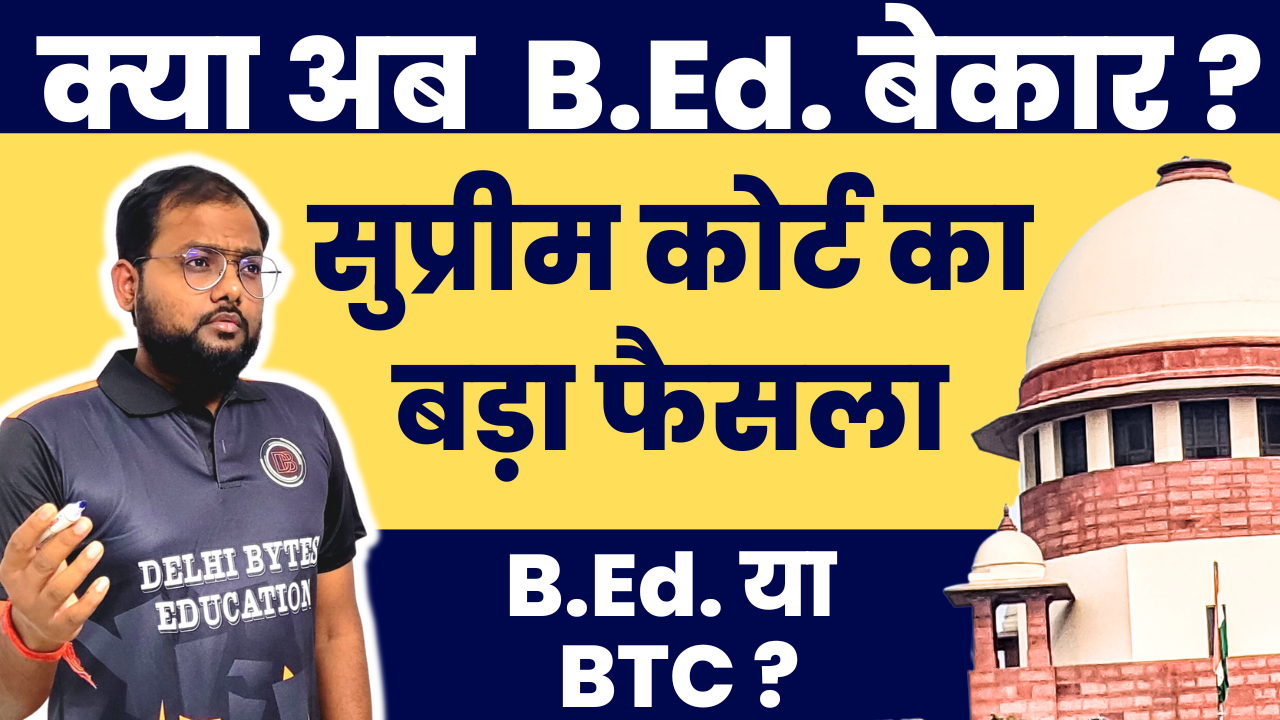
Supreme Court’s Verdict
The conflict reached the Supreme Court, recognizing that B.Ed. degree holders are not qualified to teach students at the Primary level of schooling. Since B.Ed. training focuses on preparing teachers for post-primary, secondary, and higher levels, they lack the pedagogical skills and training required to teach young children. In contrast, D.El.Ed. training, also known as the diploma in elementary education or BTC , is specifically designed and structured for teachers intending to teach Primary-level students. In addition, the inclusion of B.Ed. as a qualification would dilute the quality of education at Primary-level and go against the spirit of the fundamental right enshrined in the constitution under Article 21A which calls for a free, compulsory and meaningful primary education to children. Therefore, the Court deemed B.Ed. degree holders ineligible for primary teacher recruitment roles.
Ramifications
The Supreme Court’s decision has far-reaching consequences, especially for B.Ed. and BTC candidates across the country. The much-anticipated KVS PRT Result 2023 is expected to be influenced by the verdict, and speculations suggest that the Kendriya Vidyalaya Sangathan (KVS) was, in fact, in a holding pattern, waiting for the High Court’s pronouncement before advancing applications from B.Ed.-qualified candidates for Primary Teacher positions. Therefore, B.Ed. graduates will now find their aspirations for Primary school teaching roles thwarted, while their BTC counterparts have the avenue to pursue such positions.
Conclusion
The B.Ed. vs BTC debate, arising from the 2018 NCTE notification, has evolved into a legal, educational, and employment conundrum. The Supreme Court’s resolute judgment has set a precedent, shaping the future of prospective educators across the nation. As stakeholders ponder the implications, the discourse continues to resonate within academic circles and policy corridors alike.