
INTRODUCTION:
“A teacher can never truly teach unless he is still learning himself. A lamp can never light another lamp unless it continues to burn its own flame.”
The introduction of the B.El.Ed. Programme marks a move towards the creation of a cadre of Elementary Education professionals. The Bachelor of Elementary Education (B.El.Ed.) programme is a four-year integrated professional degree programme of Elementary Teacher Education offered after the senior secondary stage of school i.e Class XII. This programme is designed to integrate the study of subject knowledge, human development, pedagogical knowledge and communication skills. The programme offers compulsory and optional theory courses, compulsory practicum courses and a comprehensive school internship experience. At present, the programme is being offered in eight women colleges of the University of Delhi. The regulations, norms and standards for the B.El.Ed. Programme were first notified by the NCTE in the Gazette of India on March 20, 1999. The latest notification applicable to the programme is dated November 2014.
SCOPE OF B.EL.ED:
The B.El.Ed. Programme aims to produce graduates of high calibre in the field of elementary teacher education. This is a programme that allows one to put into practice many of the theoretical ideas that one has on education. It offers immense scope for incorporating inter-disciplinary ideas through projects, colloquia and other such activities. The programme allows students to interact continuously between the outside world and the classroom.
Some of the professional and academic options available for the B.El.Ed. graduates are:
- B.El.Ed graduates are eligible for appointment as PRTs, TGTs in MCD, NDMC, Sarvodaya Vidyalayas in Delhi, Kendriya Vidyalayas and Navodaya Vidyalayas, state government schools all across India and private schools too.
- Eligible in elementary school systems in various capacities like curriculum developers, content developers etc.
- Can pursue research in education and related disciplines in the government and non-government sectors.
- Can pursue post-graduate courses and research studies in education.
- Last but not the least, can serve as teacher-educators in various State Institutes and University Departments/ Colleges offering training in elementary/secondary education.
ELIGIBILITY CRITERIA:
- For appearing in the CUET (UG), there is no age limit for the candidates.
- The candidates must have passed the Class XII or its equivalent examination from a single recognized board in class XII examinations.
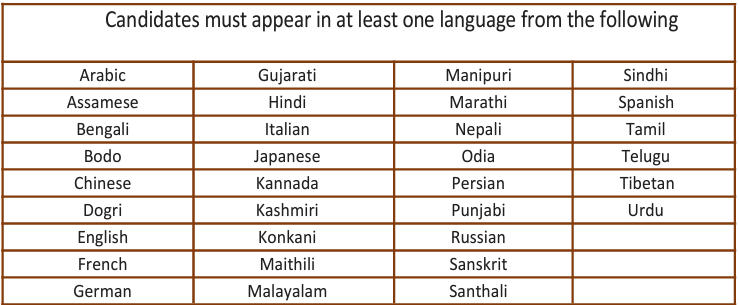
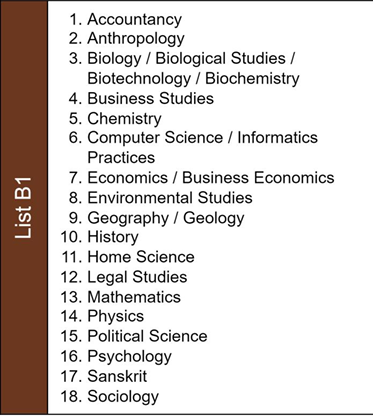
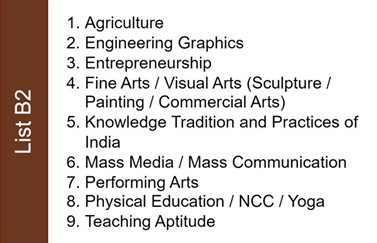
- Candidate must appear in CUET in the following subject combination:
Any one Language from List A
+
Any two subjects from List B1
+
Any one subject from either List B1 or List B2
Merit will be based on the CUET scores obtained from the above-mentioned combination.
- No admission is allowed on the basis of Sports and ECA category.
- The candidates will be required to fulfill the age criteria (if any) of the University / Institution / Organization in which they are desirous of taking admission.
· NOTE: It is mandatory for the candidates to appear in CUET(UG)-2023 in those subjects in which s(he) is appearing/has passed ClassXII.
OFFERED BY COLLEGES AND SEAT RESERVATION:
The B.El.Ed. Programme is offered in the following eight women colleges of University of Delhi and the details of the seats are given below:
S.No. | College Name | UR | OBC-NCL | SC | ST | EWS | Sikh | Christian | PwBD | CW | KM | TOTAL |
1 | Aditi Mahavidyalaya(W) | 25 | 17 | 9 | 5 | 7 | 0 | 0 | 3 | 3 | 3 | 72 |
2 | Gargi College(W) | 25 | 17 | 9 | 5 | 7 | 0 | 0 | 3 | 1 | 1 | 68 |
3 | Institute of Home Economics (W) | 26 | 17 | 9 | 5 | 6 | 0 | 0 | 3 | 3 | 0 | 69 |
4 | Jesus & Mary College(W) | 25 | 0 | 0 | 0 | 0 | 0 | 25 | 3 | 3 | 0 | 56 |
5 | Lady Shri Ram College for Women(W) | 25 | 17 | 9 | 5 | 7 | 0 | 0 | 3 | 3 | 3 | 72 |
6 | Mata Sundri College for Women(W) | 27 | 0 | 0 | 0 | 0 | 27 | 0 | 3 | 3 | 3 | 63 |
7 | Miranda House(W) | 25 | 17 | 9 | 5 | 7 | 0 | 0 | 3 | 3 | 3 | 72 |
8 | Shyama Prasad Mukherji College For Women(W) | 25 | 17 | 9 | 5 | 7 | 0 | 0 | 3 | 3 | 3 | 72 |
NOTE: Seat Matrix is as per the information provided by the colleges. The number of seats may vary. Supernumerary seats will be as per University of Delhi norms.
CUET EXAM PATTERN:
Mode of Examination:
- CUET (UG) is completely conducted in Computer Based Test (CBT)
Medium of Examination:
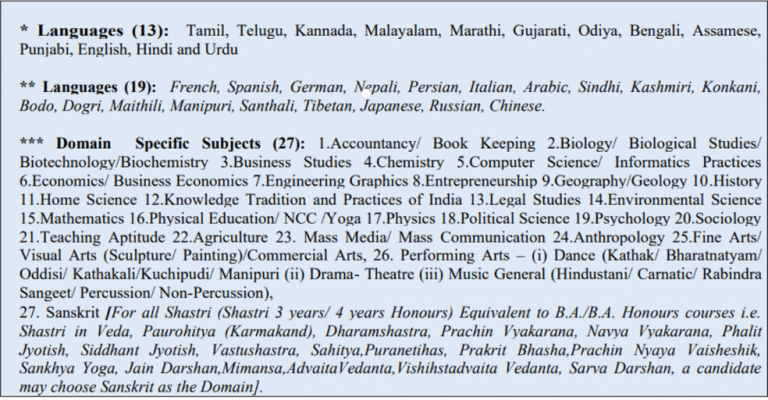
- CUET (UG) will be conducted in 13 languages e. English, Hindi, Assamese, Bengali, Gujarati, Kannada, Malayalam, Marathi, Odia, Punjabi, Tamil, Telugu, and Urdu.
NOTE: The option of language for Question Paper should be exercised while filling up the Application Form online and it cannot be changed at a later stage.
NOTE: Please note that for the correctness of the questions in all the question papers, the English version will be taken as the final.
Scheme of Examination:
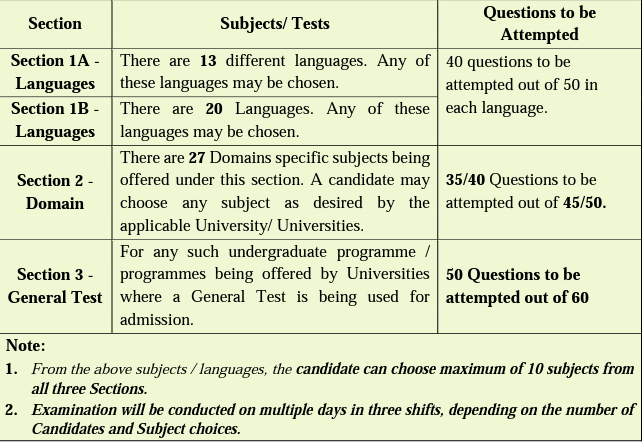
Subject combinations for each paper, type of questions in each paper, and mode of examination are given in the table below:
- A candidate can choose maximum of any 3 languages from Section IA and Section IB taken together. (One of the languages chosen needs to be in lieu of Domain Specific subjects)
- Section II offers 27 subjects, out of which a candidate may choose maximum of 6 subjects.
- For choosing languages (up to 3) Section IA and Section IB and a maximum of 6 subjects from Section II and General Test under Section III, the candidates must refer to the requirements of his/her intended University.
Pattern of Question Paper:
- Objective type- Multiple Choice Questions (MCQs).
Duration of Test:
- Examination will be conducted on multiple days in three slots per day.
NOTE: Compensatory time for PwBD Candidates of 20 minutes for each hour examination will be given.
NOTE: Examination will be conducted on multiple days in three shifts, depending on the number of Candidates and Subject choices.
Level of questions:
All questions in various testing areas will be benchmarked at the level of Class XII only.

CUET EXAM SYLLABUS:
LANGUAGE:
- Language to be tested through Reading Comprehension based on different types of passages–Factual, Literary and Narrative, and Literary Aptitude and Vocabulary.
DOMAIN SUBJECT:
GENERAL TEST:
- General Knowledge, Current Affairs, General Mental Ability, Numerical Ability, Quantitative Reasoning (Simple application of basic mathematical concepts arithmetic / algebra geometry / mensuration /stats), Logical and Analytical Reasoning.
CONCLUSION:
The strength of B.El.Ed lies not only in its commitment to nurturing proficient teachers but also in its broader contribution to education as a whole. The program’s emphasis on holistic child development, inclusive education, and community engagement ensures that its graduates are poised to become catalysts for positive change in the education sector. This holistic approach not only enhances the quality of teaching but also empowers educators to be advocates for equitable education, serving as pillars of transformation in their communities.
In conclusion, the B.El.Ed program shines as the best teacher education course by virtue of its forward-thinking curriculum, which moulds educators into well-rounded professionals ready to face the evolving challenges of education. Its dedication to fostering compassionate, adaptable, and socially conscious teachers cements its role as a cornerstone in shaping the future of education for the better. B.El.Ed not only shapes teachers; it shapes the very landscape of learning itself.
DELHI BYTES is the transformative oasis for aspiring educators. The meticulously curated resources and best content provide a nurturing environment for skill development and pedagogical growth. Emphasis on practical application ensures that knowledge translates seamlessly into the classroom, producing confident and effective teachers.
To boost your performance, Delhi Bytes provide One to One Live Interaction Batches making this platform an invaluable tool for shaping the future of education. The ability to convey complex concepts with clarity and enthusiasm is a gift that all the faculty members of the platform have.