
The Haryana Teacher Eligibility Test (HTET): Empowering Educators
The Haryana Teacher Eligibility Test (HTET) stands as a pivotal gateway for individuals aspiring to shape young minds in the state’s educational institutions. Established by the Board of School Education Haryana (BSEH), the HTET is a comprehensive assessment that evaluates the eligibility of candidates for teaching roles across different levels. This examination plays a crucial role in ensuring the quality of education delivered in Haryana’s schools and has a far-reaching impact on the educational landscape of the state.
This examination takes place annually, offering candidates the opportunity to apply multiple times in order to enhance their results. The validity of an HTET qualifying certificate extends for a duration of five years, commencing from the date of successfully clearing the Haryana TET Exam.
Origin and Importance
The HTET was introduced to address the need for qualified and competent teachers in both government and private schools in Haryana. The quality of education imparted is directly linked to the expertise and abilities of educators. The state recognized the significance of a robust selection process to identify individuals who possess the necessary pedagogical skills, subject knowledge, and dedication to effectively nurture the intellectual growth of students.
Structure and Levels
The HTET is structured into three distinct levels, each catering to a specific tier of education:
- Level 1: This level targets candidates aspiring to teach classes I-V, commonly referred to as the primary stage. The examination assesses their understanding of child development, pedagogical approaches, and foundational concepts across subjects.
- Level 2: Candidates aiming to teach classes VI-VIII, the upper primary stage, fall under this category. Known as Trained Graduate Teachers (TGTs), they are evaluated on their proficiency in subject matter, teaching methodologies, and adolescent psychology.
- Level 3: Targeting the higher secondary stage (classes IX-XII), this level assesses candidates who wish to become Post Graduate Teachers (PGTs). Their in-depth knowledge of their chosen subjects and advanced teaching techniques are scrutinized.
ELIGIBILITY CRITERIA
Certain educational qualifications are mandatory for candidates interested in the HTET Exam 2023, as stipulated by the National Council for Teacher Education (NCTE).
- Those aged between 18 and 38 years are eligible to apply for HTET 2023.
- It’s essential to note that the state government reserves the right to modify the qualification and eligibility criteria according to the Government Orders (GOs) issued for the HTET Exam.
Primary Teacher (1st to 5th class)
For the Primary Teacher level (1st to 5th class), candidates must fulfill one of the following educational criteria:
- Successful completion of Senior Secondary or its equivalent with a minimum of 50% marks, along with a two-year Diploma in Elementary Education following the NCTE regulations of 2007.
- Attainment of Senior Secondary or any equivalent with 45% or more marks, coupled with a two-year Diploma in Elementary Education as per the NCTE regulations of 2002.
- Senior Secondary or equivalent with 50% or more marks and either completed or appearing in the final year of the 4-year B.El.Ed course.
- Senior Secondary or equivalent with 50% or more marks, and completion or appearance in the final semester of the two-year Diploma in Education (Special Education).
- Graduation completion or appearance in the final year of a two-year Diploma in Elementary Education.
- Successful Matriculation with Hindi/Sanskrit or completion of Senior Secondary/Graduation/Post Graduation with Hindi.
Trained Graduate Teacher (6th to 8th class)
For the Trained Graduate Teacher level (6th to 8th class), candidates must meet the following educational prerequisites:
- Possession of a Bachelor’s degree and completion or appearance in the final year of a two-year Diploma in Elementary Education.
- Graduation in the relevant stream with at least 50% marks, along with completion or pursuit of a one-year Bachelor in Education (B.Ed).
- Senior Secondary or equivalent with 50% or more marks and completion or pursuit of the final semester of the four-year B.El.Ed (Bachelor in Elementary Education).
- Senior Secondary or equivalent with 50% or more marks and completion or appearance in the last year of the four-year B.A/B.Sc.Ed or B.A.Ed/B.Sc.Ed.
- Graduation in a relevant discipline with a minimum of 50% marks, and passing or appearance in a one-year B.Ed. (Special Education).

Post Graduate Teacher (11th and 12th class)
For the Post Graduate Teacher level (11th and 12th class), candidates must fulfill the subsequent educational conditions:
- Successful completion of post-graduation in the respective subject with 50% or above marks.
- Attainment of a Bachelor of Education degree. (B.Ed. degree)
- Completion of Matriculation in Hindi and Sanskrit or Senior Secondary/Graduation/Post Graduation in Hindi with a strong academic record.
Meeting these educational standards is imperative to be considered eligible for the HTET Exam. It is essential for aspirants to carefully understand and fulfill these requirements to ensure a smooth application process and enhance their prospects in the teaching domain.
Application Procedure
The application procedure for HTET 2023 is anticipated to commence around November-December 2021. Prospective applicants are expected to complete the registration process for the examination online.
Step 1: Registration
The application forms are accessible on the official website (www.bseh.org.in). Aspiring candidates should navigate to the website and locate the “HTET application form” link displayed on the homepage. It’s imperative to thoroughly review all provided instructions and verify their eligibility against the outlined criteria. Based on their eligibility, candidates can opt for the desired post they intend to apply for. Subsequently, they should furnish the application form with their personal particulars, academic history, and relevant identity proof details. After completing the necessary entries, candidates should save their progress and subsequently click the “submit” button. Following this, a provisional User ID and registration number will be dispatched to the email address registered.
Step 2: Payment of the Application Fee
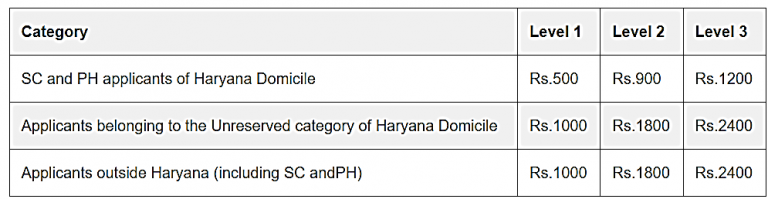
As part of the application process, candidates are required to submit a recent passport-sized color photograph, along with scanned copies of their signature and thumb impression, adhering to the prescribed specifications. To finalize the registration procedure, candidates need to remit the application fee through online channels, employing available methods such as Debit/Credit Card or Net Banking. It’s advisable to retain a printout of the payment confirmation once the transaction is successfully completed. The HTET application fee varies based on the different levels, as follows:
Components of the HTET Examination
The HTET examination comprises several components, each designed to gauge specific aspects of a candidate’s aptitude for teaching:
- Child Development and Pedagogy: This section evaluates an individual’s understanding of the cognitive, emotional, and social development of children. It assesses their ability to create a conducive learning environment and adapt teaching methods to diverse student needs.
- Language I and II: Proficiency in languages is vital for effective communication in the classroom. This section examines a candidate’s command over the language they will teach, as well as their ability to explain concepts clearly.
- Mathematics and Environmental Studies: For Level 1, these subjects are essential, as they form the foundation of primary education. Candidates’ knowledge of these subjects and their capacity to convey complex ideas in an accessible manner are scrutinized.
- Subject-Specific Content: Candidates appearing for Levels 2 and 3 must demonstrate an in-depth understanding of their chosen subjects. This section emphasizes their mastery of the subject matter and their ability to impart knowledge effectively.
EXAM PATTERN
The configuration of the Haryana Teacher Eligibility Test (HTET) examination is contingent upon the chosen level of the test. Here are the principal features of the examination format:
- · A total of 150 questions comprise the examination.
- · The questions adopt an objective format, employing multiple-choice questions (MCQs).
- · The allotted duration for the examination is 2 hours and 30 minutes.
- · Each correct response is rewarded with 1 mark.
- · Notably, no negative marking is imposed for incorrect answers.
- · The examination paper is available in both Hindi and English languages.
- · For Level 2 and Level 3, a specific segment is dedicated to the subject the candidates opt for.
- · A uniform General Studies section is included in all examinations across levels, encompassing questions related to current affairs, Haryana’s historical context, geography, and more.
- · The alternative of a computer-based test (CBT) is also accessible.
- · Specially-abled candidates, including those who are blind or unable to write independently, receive an additional 50 minutes of examination time.
- · Individuals with a visual disability of 40% or more, or those who are incapable of writing independently, can avail of the facility of a scribe/amanuensis.
- · No specific prerequisites for educational qualifications, age, etc., are mandated for the scribe/amanuensis.
Primary Teacher (1st to 5th class)
Section | No. of questions | Marks allotted |
Quantitative Aptitude, Reasoning Ability and General Awareness | 30(10+10+10) | 30 |
Child Development and Pedagogy | 30 | 30 |
Language (Hindi and English) | 30 (15+15) | 30 |
Mathematics | 30 | 30 |
Environmental studies | 30 | 30 |
Total | 150 | 150 |
Trained Graduate Teacher (6th to 8th class)
Section | No. of questions | Marks allotted |
Quantitative Aptitude, Reasoning Ability, and General Awareness | 30(10+10+10) | 30 |
Child Development and Pedagogy | 30 | 30 |
Language (Hindi and English) | 30 (15+15) | 30 |
Particular Subject they opted for | 60 | 60 |
Total | 150 | 150 |
Post Graduate Teacher (11th and 12th class)
Section | No. of questions | Marks allotted |
Quantitative Aptitude, Reasoning Ability and General Awareness | 30(10+10+10) | 30 |
Child Development and Pedagogy | 30 | 30 |
Language (Hindi and English) | 30 (15+15) | 30 |
Particular Subject they opted for | 60 | 60 |
Total | 150 | 150 |
Impact on Education Quality
The HTET’s influence on education quality is multi-faceted:
Elevating Teaching Standards: By setting a rigorous benchmark, the HTET ensures that only qualified individuals enter the teaching profession. This leads to improved teaching standards and enhances the overall learning experience for students.
Enhancing Pedagogical Skills: The test’s focus on pedagogy equips teachers with a range of teaching strategies. This enables them to adapt their methods to suit diverse learning styles, resulting in a more inclusive and effective classroom environment.
Creating a Learning-Focused Ecosystem: Schools and educational institutions are more likely to prioritize hiring HTET-qualified educators. This shift encourages a culture of continuous learning and professional development among teachers, which ultimately benefits students.
Challenges and Future Directions
While the HTET has undoubtedly contributed to elevating education quality in Haryana, there are challenges to address:
Rural-Urban Disparities: Ensuring that teachers from all regions have access to HTET preparation resources can bridge the gap in teaching quality between rural and urban areas.
Adapting to Changing Educational Needs: The HTET must evolve to align with changing educational paradigms, including digital learning, experiential teaching methods, and the integration of new technologies.
Continued Professional Development: To maintain the high standards set by the HTET, ongoing professional development opportunities should be provided for teachers to stay updated with the latest teaching methodologies and subject knowledge.
CONCLUSION
In conclusion, the Haryana Teacher Eligibility Test (HTET) has significantly contributed to the elevation of teaching standards in Haryana. By assessing candidates’ pedagogical skills, subject expertise, and commitment to education, the HTET ensures that only the most qualified individuals become torchbearers of knowledge in the state’s schools. As the educational landscape evolves, the HTET must continue to adapt and innovate to foster excellence in teaching and learning.